“I shipped my whole project by putting 200 agents to work. In 3 hours.”
The myth?
← → · S = speaker
“Several agents”: what does it change?
- Shipping faster?
- Handing off part of the work?
- Actually running AIs in parallel?
“Several agents” = 6 meanings.
1 / 6
Several sessions.
1 · Several sessions
By hand, in the terminal.
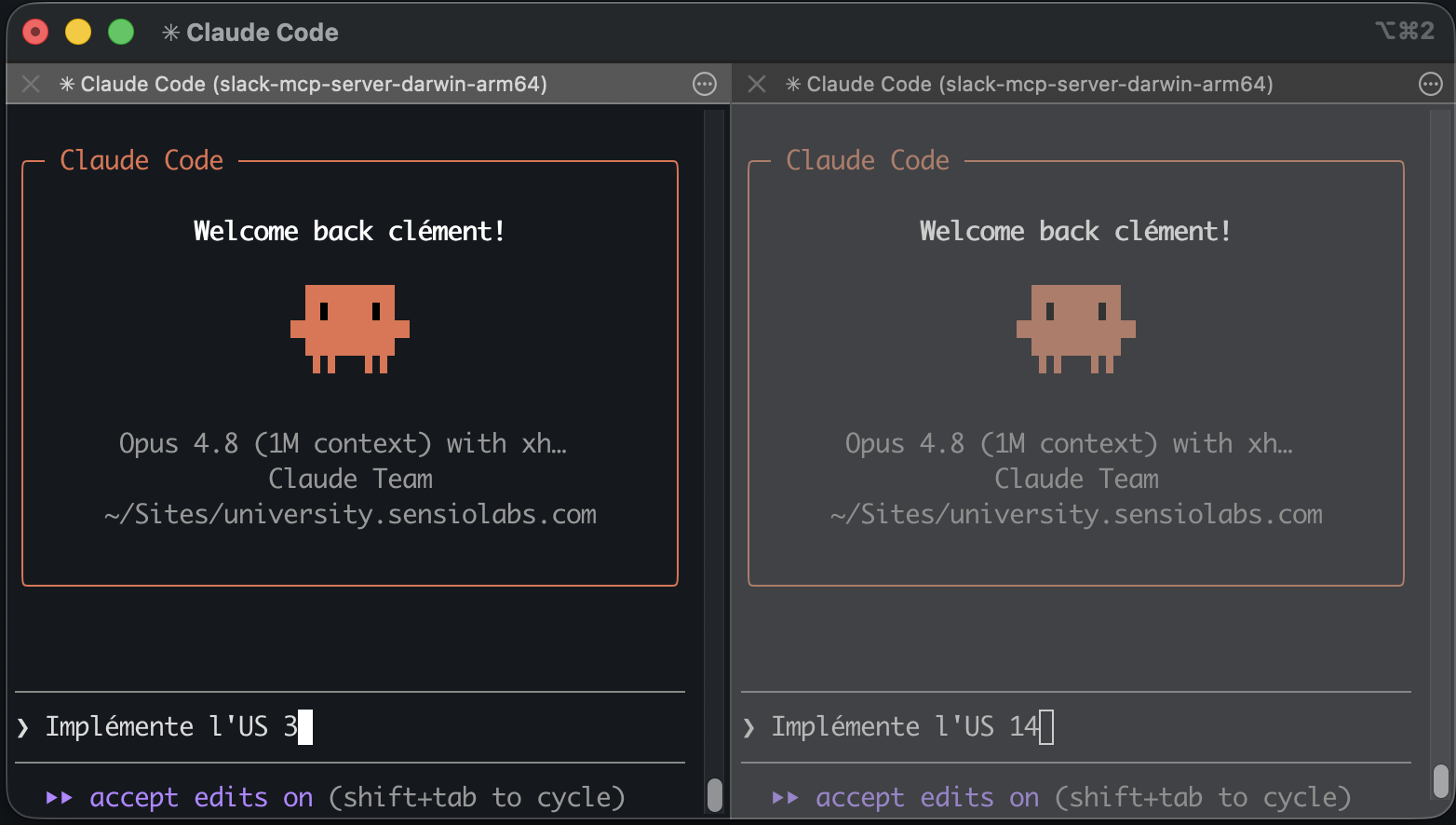
1 · Several sessions
Claude + Codex, side by side.
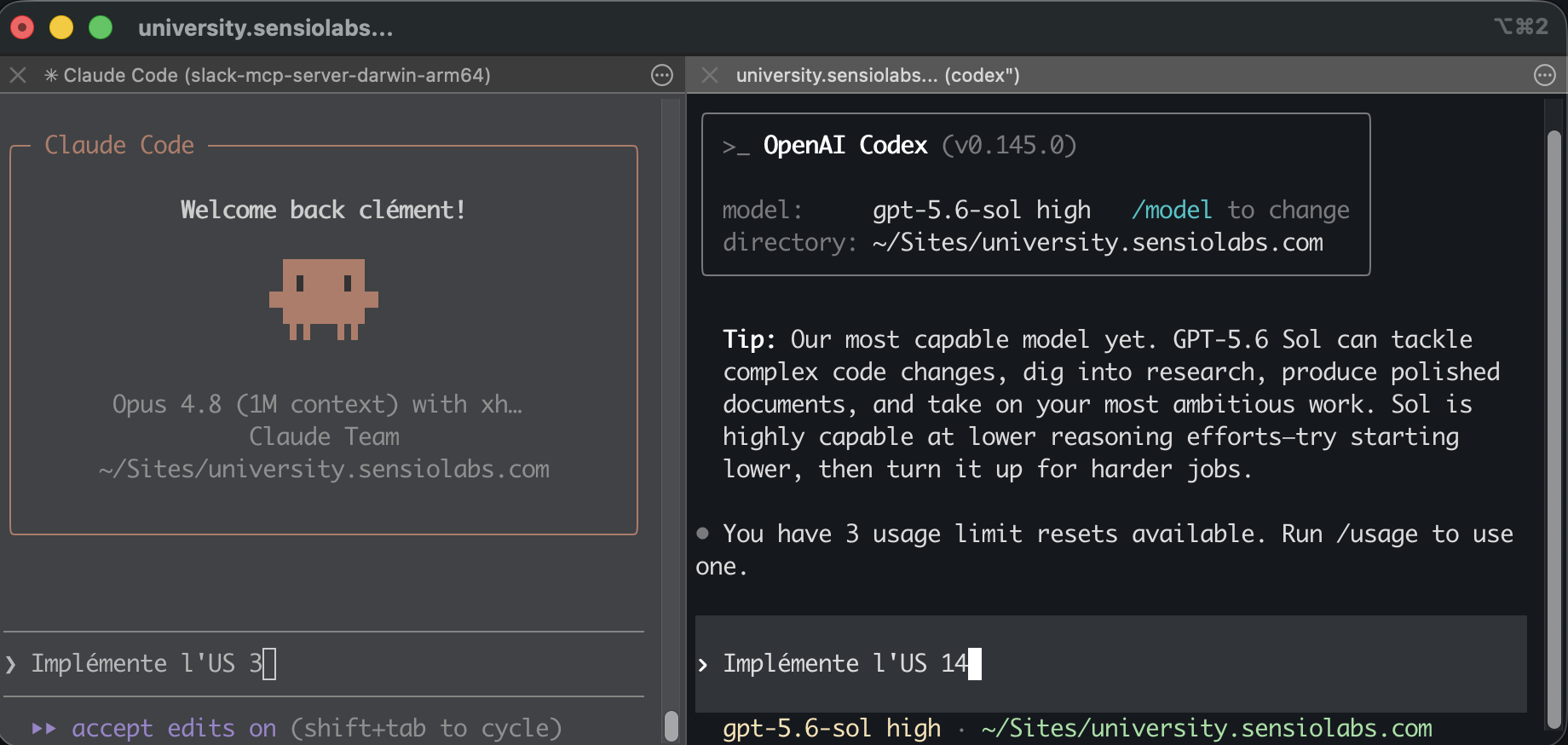
1 · Several sessions
Or in the desktop app.
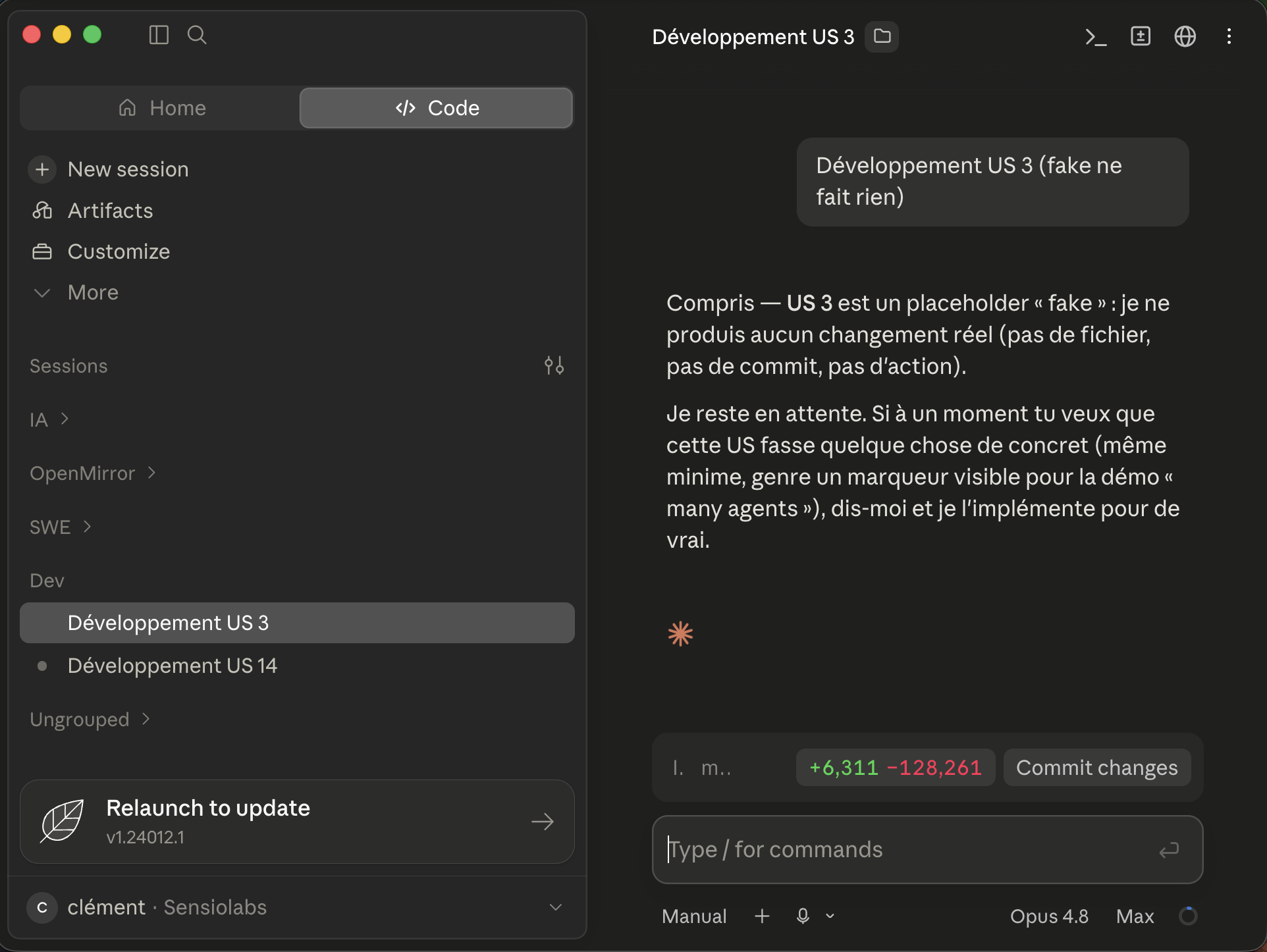
1 · Several sessions
Isolating each track: worktrees.
$ git worktree add ../jobs-a -b feat-a
$ git worktree add ../jobs-b -b feat-b
$ export HTTP_PORT=18082 COMPOSE_PROJECT_NAME=jobs_a
Isolated Git ≠ isolated Docker: one port set per track, or they collide.
2 / 6
Its subagents.
2 · Subagents
One agent, several subagents.
> Spin up a subagent to audit
  security, another one for performance.
  Then summarise both for me.
> Regression on the homepage since yesterday.
  3 subagents: the recent diff, the failing
  tests, the logs. What is the likely cause?
2 · Subagents
A burst, with no script: ultracode.
> ultracode: audit every endpoint under
  src/Controller/ — the missing access checks
# the agent writes the script, fires ~15 subagents,
# live progress in /workflows
One keyword: the agent writes the orchestration script itself and fires the whole burst in parallel. docs · paid plan · ≠ ultrathink (think harder)
2 · Subagents
What is tunable.
| Claude Code | Codex | |
|---|---|---|
| nesting (a subagent spawning one) | 5 levels · fixed | 1 · tunable (max_depth) |
| in parallel (concurrent) | no documented cap | 6 · tunable (max_threads) |
| total / session | 200 · tunable | no cap |
| model per agent | yes · from the prompt | yes · TOML |
> Big refactor of the Payment module: one subagent
  per subfolder, on sonnet. Keep opus for the summary.
“38 subagents” = a session total, not 38 at the same time.
code.claude.com/docs/en/sub-agents · learn.chatgpt.com/…/subagents
2 · Subagents
Subagent ≠ background task.
Subagent
A delegated agent: its own context, its own tools, hands back a summary.
Background task
A long-running shell process (dev server, tests). No AI — you just read its output.
Ctrl+B backgrounds either one · /tasks = the shared panel.
3 / 6
Delegation.
3 · Delegation
One agent calls another.
> Implement this cache.
  In parallel, ask Codex
  to do it too — we will compare.
> Implement this cache.
  Once it is done, ask Codex
  for a review before I look at it.
4 / 6
Profiles.
4 · Profiles
Defining distinct agents.
---
name: code-reviewer
description: Reviews code for quality and best practices
tools: Read, Glob, Grep
model: sonnet
---
You are a code reviewer. Analyze the code and give feedback.
Not just Claude, and not just subagents: Codex has its own (.codex/agents/*.toml) — but there is no shared format. docs
5 / 6
Homemade orchestration.
5 · Homemade orchestration
Industrialising it: a skill.
---
name: cross-review
description: implement, then have another agent review it
---
1. Implement the requested task.
2. Ask Codex for an independent review.
3. Reconcile the divergences, summarise.
Cheap, portable — but the loop is still driven by the model.
5 · Homemade orchestration
First, the agent on the command line.
$ claude -p "Audit the security of src/Payment/"
$ codex exec "Audit the security of src/Payment/"
Non-interactive: the prompt goes in as an argument. That is the brick you script.
5 · Homemade orchestration
… then a script to orchestrate.
import subprocess, concurrent.futures as cf
PROMPT = "Audit this module, be critical."
AGENTS = [["claude","-p"], ["codex","exec"]]
run = lambda c: subprocess.run(c+[PROMPT], text=True, capture_output=True).stdout
with cf.ThreadPoolExecutor() as ex:
    for out in ex.map(run, AGENTS): print(out)
Deterministic, versionable, 0 token for the loop. Repeated and stable → the script wins. E.g. prompt-fleet.
6 / 6
The orchestrators.
6 · Orchestrators
When a board drives the agents.
Superset
10 to 100+ CLI agents in parallel, each in its own worktree. superset.sh
Conductor
Mac app: Claude / Codex / Cursor in parallel, worktree + live diff. conductor.build
Multica
Agents as teammates on a board: identity, queue, audit trail. multica-ai/multica
GitHub Agent HQ
“Mission control”: driving N agents, whatever the provider. github.blog
Adjacent
Adjacent: SpecKit, BMAD.
Spec Kit
Single agent, sequential (/specify → /plan → /tasks → /implement). One agent at a time. Multi is only a third-party extension (MAQA). github/spec-kit
BMAD-METHOD
Named roles (PM, Architect, Dev…), a sequential pipeline of documents. “Party mode” = every role in one room, arguing. bmad-code-org/BMAD-METHOD
Roles and sequencing — not parallel agents on independent tasks.
Comparison
Which meaning for which need.
| Meaning | Parallel | Effort | Best for |
|---|---|---|---|
| several sessions | yes | low | independent features |
| subagents | yes | low | audits · research |
| delegation | parallel or sequence | low | second opinion · review |
| profiles | cross-cutting | low | specialising a role |
| homemade orchestration | yes | medium | repeated · deterministic |
| orchestrators | yes | high | team · board |
More agents =
more slicing.
Not more hands. The right move for the right problem.